


Forget your 8K textures and celebrity voice actors. Picture a scrappy horror game, built by a single developer, with visuals pulled straight from the PS1 era. This is the game that stormed Steam charts, outpacing multi-million-dollar blockbusters to become an obsession. This is the Lethal Company phenomenon.
And here’s the kicker: it didn’t just succeed despite its rough edges and low budget. It succeeded because of them. In an industry obsessed with sanitized polish and aggressive monetization, Lethal Company offered a raw, unfiltered antidote players didn’t even know they were craving: authentic social chaos.
The ‘Less Is More’ Loop: Fueling the Phenomenon
The first lesson from the Lethal Company playbook? Burn the feature list.
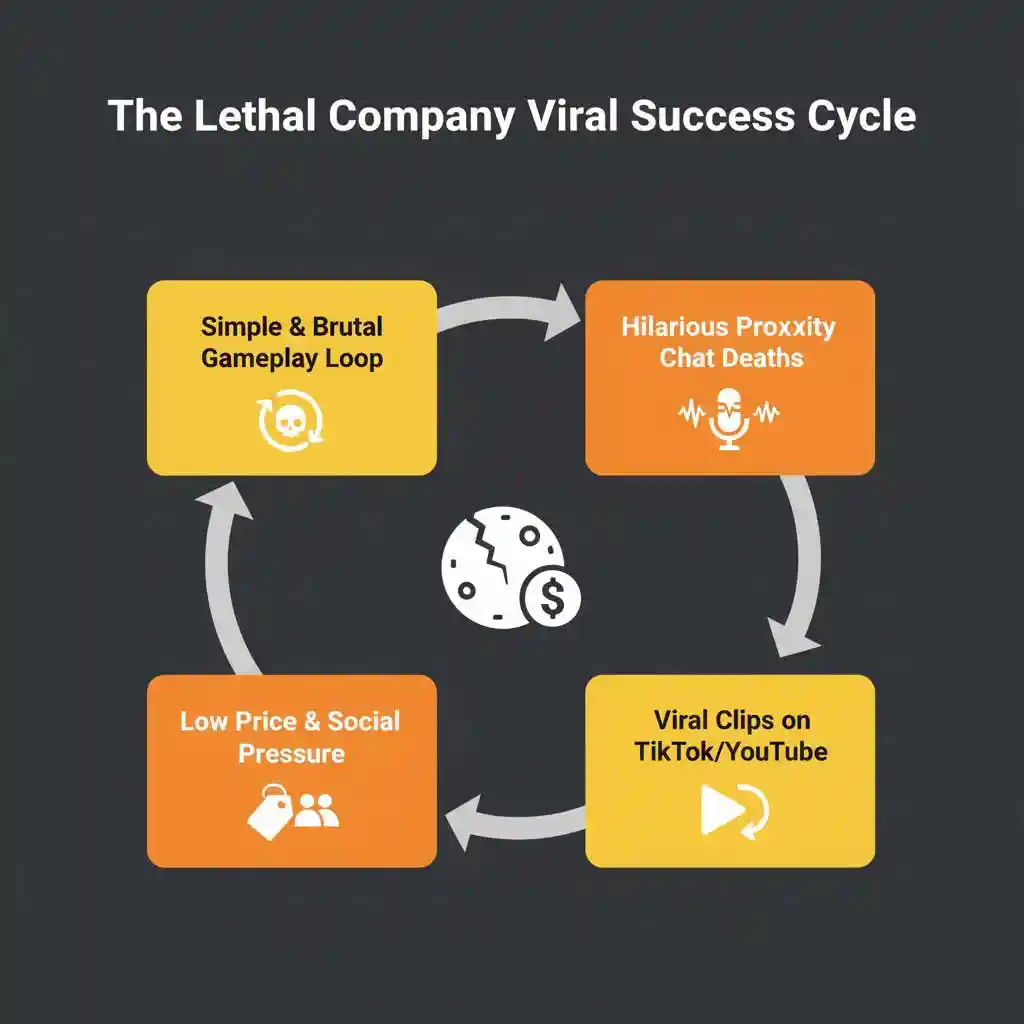
At its core, the gameplay loop is deceptively simple: land on a desolate moon, scavenge for scrap, meet your quota, and likely die in a hilarious way. There are no sprawling skill trees, no convoluted crafting systems, no 40-hour tutorial masquerading as a story. The brilliance lies in how these simple rules create infinite tension.
Read Also:
Every run becomes a high-stakes gamble. Do you risk one more piece of loot? Do you split the team? The game doesn’t hand you a crafted story; it provides a sandbox for disaster. This is “emergent narrative” at its finest—the ultimate “show, don’t tell” design, where the best stories emerge from player screw-ups and panicked escapes, keeping you talking long after you log off.
The Proximity Chat Goldmine: An Accidental Marketing Machine
Proximity chat isn’t just a feature in Lethal Company; it’s the main character. In practice, it’s a self-powering content factory.
One moment, you’re coordinating with your crew. The next, a teammate’s voice cuts to static mid-scream as something drags them into the dark. That single audio cue is both terrifying and comedic gold—perfectly clipped for TikTok, YouTube Shorts, or a Discord highlight. The game transforms players from consumers into unwitting, and often hilarious, content creators.
This stands in stark contrast to the sterile comms in most multiplayer titles. Here, the design makes communication fragile, essential, and inherently entertaining. Every failed plan becomes shareable content, and every clip acts as free marketing that perfectly captures the Lethal Company phenomenon.
It’s Not Just Scary, It’s Funny-Scary
Pure horror leads to fatigue. Pure comedy lacks tension. Lethal Company thrives in the sweet spot: a state of “tense hilarity.”
The game’s unsettling monsters and oppressive atmosphere create genuine dread. Yet, the moment-to-moment experience often resembles a slapstick comedy of errors. A friend gets blindsided by a turret. Someone yells “run!” but sprints directly into a mine. This creates a powerful feedback loop: the adrenaline from fear fuels the laughter from failure, and that laughter makes you brave enough to face the fear again. It’s “good fear”—an addictive cocktail of adrenaline and absurdity that makes the suffering fun.
The Zeekerss Factor: A History of Unconventional Horror
But this blend of horror and comedy is no accident. Lethal Company didn’t materialize from a vacuum; its success is the culmination of years of experiments by its creator, Zeekerss.
Dig through his itch.io and Steam catalog, and you’ll see the blueprint forming long before launch. Games like The Upturned (2019) showcased his obsession with physics-driven chaos, while It Steals (2020) perfected the art of minimalist horror, hunting players with an invisible predator. The DNA—resource management under pressure, trial-and-error survival—is unmistakable.
Zeekerss never chased photorealism. His design philosophy is systemic: create simple mechanics, let them interact in unpredictable ways, and watch players improvise. So when Lethal Company exploded, it wasn’t lightning striking out of nowhere. It was a storm that had been brewing for years, finally making landfall.
Lightning in a Bottle: Echoes of Phasmophobia & Among Us
As singular as it feels, the Lethal Company phenomenon walks a path paved by other indie giants, revealing a repeating pattern for modern viral success. It shares its core DNA with both Phasmophobia and Among Us.
| Viral Success Pillar | Lethal Company | Phasmophobia | Among Us |
| Social Stage | Chaos & comedy from team failures. | Confusion & suspense during ghost hunts. | Debate, accusations, & betrayal. |
| Highly “Watchable” | Hilarious proximity chat deaths. | Genuine jump scares & streamer reactions. | Dramatic accusation moments. |
| Low Barrier to Entry | $10 price point, low system specs. | Affordable price, frequent sales. | Cheap on PC, was free on mobile. |
- Pillar #1: Gameplay as a Social Stage. These titles aren’t about “winning”; they are stages for human interaction. Whether it’s accusing friends in Among Us or watching a teammate implode in Lethal Company, the real content is the social friction.
- Pillar #2: Incredibly Watchable. The rules are instantly legible to viewers, and the drama unfolds in real-time. That watchability fuels a viral cycle: people see clips, get curious, buy the game, and create new clips for others to see.
- Pillar #3: Low Barriers to Entry. A cheap price point and low system requirements turn curiosity into sales at scale. Friends don’t debate buying in; they just do.
Lethal Company is the latest refinement of this formula: design games not just as systems to play, but as stages to perform on, with virality baked into the loop.
What AAA Studios Forgot: Respect for the Player
But a brilliant stage is useless if no one shows up. This brings us to Lethal Company’s most powerful, and perhaps simplest, lesson for the industry: its business model.
At just $10, it respects the player. There’s no battle pass preying on your FOMO, no premium currency to obscure real-world costs, no algorithmically-priced skin packs. You buy the game, you get the game. Full stop.
In 2025, this straightforward honesty feels radical. It’s not a revolution; it’s a simple, powerful reminder of the bargain gaming used to offer: a complete experience for a fair price.
The Final Verdict: A Stage for Chaos
So, what does the Lethal Company phenomenon teach us?
We have a story-generating machine disguised as a game loop. A communication tool that moonlights as a viral marketing engine. A horror experience that makes you laugh, and a business model that respects you. The lesson isn’t that gamers want worse graphics. It’s that they crave experiences that feel alive, unpredictable, and player-driven.
Maybe the future of gaming isn’t about bigger maps or prettier shaders—it’s about smarter systems that let us write our own chaos.
Lethal Company doesn’t sell a narrative. It sells a stage.
And judging by its success, that stage is exactly what we’ve been waiting for.


