


You’ve been there. You’re watching a pro tournament from North America or Europe, hyped to see some high-level gameplay. Then it happens. The enemy first-picks Bane. You blink, refresh the stream, and maybe even laugh a little. “They can’t be serious,” you think, remembering the last time someone picked him in your ranked game and got flamed into oblivion.
But here’s the secret: they are dead serious. And they might just win the game with him.
If you’ve ever felt that disconnect, you’ve stumbled upon one of the most fascinating aspects of Mobile Legends: the unwritten rules of its regional metas. The idea that a hero is universally “good” or “bad” tells only half the story. The truth is, the way the game is played in the chaotic, kill-hungry servers of Indonesia is fundamentally different from the 5-man deathball perfected in the Philippines, which is again a world away from the strategic chess played in EU/NA.
So, before we dive in, let’s get one thing straight. The meta is a living, breathing thing. This analysis is a snapshot of the game as we see it in 2025; a picture of the dominant trends, not a permanent rulebook. There are always teams who are the exception that proves the rule. Our goal here isn’t to be the final word, but to start a conversation.
Ready? Let’s pull back the curtain.
A Tale of Three Philosophies: More Than Just East vs. West
For a long time, we simplified the meta as “Asia’s aggression vs. the West’s strategy.” That’s outdated. The real story is a fascinating clash of three distinct schools of thought.
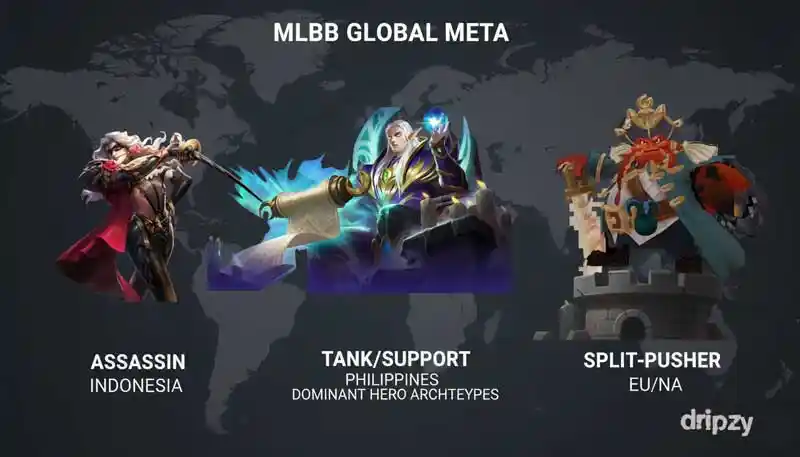
- The Indonesian School (The Berserkers): Win lane, win game. This philosophy is all about raw mechanical skill, early-game kills, and snowballing so hard the enemy wants to surrender at minute five.
- The Philippine School (The Roman Legion): The undisputed masters of the 5-man teamfight. Their famous “UBE Strategy” is about creating a perfect, unstoppable unit that moves and fights as one.
- The EU/NA School (The Guerrilla Fighters): If you can’t win a straight fight, don’t take one. This philosophy is about avoiding the enemy’s strength, creating chaos across the map, and winning through superior macro strategy.
Read Also:
- PH vs ID MLBB Meta: The Ultimate Chess vs. Boxing Breakdown
- MLBB Lore: The Abyss and Moniyan’s Hidden Connection
Heroes that are celebrated in one school are often benched in another.
The Gold Standard: Understanding the Philippine “UBE” Deathball
To understand why the West plays the way it does, you first have to understand what they’re up against: the Philippine “Ultimate Bonding Experience” (UBE). This strategy, perfected by world champion teams, is about drafting for the perfect 5v5. With ultra-durable frontliners like Fredrinn and a constant stream of healing from supports like Estes, they become an unbreakable wall. Generally speaking, their goal is to force a fight at the Lord pit and simply out-sustain you. They don’t just win fights; they win wars of attrition.
Playing a Different Game: The West’s Macro-Centric Answer
Teams in EU/NA looked at the impenetrable UBE fortress and decided not to lay siege. Instead, they opted to cut off the supply lines. Their entire approach is cut from a different cloth. It’s less about winning the decisive battle and more about winning the war across the entire map.
This means they live and breathe macro play. They will happily trade a Turtle for two turrets. They will sacrifice a player to allow their split-pusher to take an inhibitor. They are constantly asking, “How can we force the enemy to be in two places at once?” This philosophy opens the door for a completely different roster of heroes to shine.
The Misfits Brigade: Heroes Who Thrive in the West
Let’s look at the heroes who are often misunderstood in Asia but are staples in the Western playbook.
- Bane: The Boogeyman of the Side Lanes In SEA, Bane is often seen as a one-trick pony. In EU/NA, that one trick wins championships. A Western team will use Bane as a constant, nagging threat that forces the enemy to break their precious 5-man formation. While four members stall and defend, Bane becomes a one-man wrecking crew, melting turrets and creating unbearable pressure.
- Carmilla: The Unsung Hero of the Skirmish The UBE style needs a “press one button and win the fight” ultimate from tanks like Atlas. Carmilla is more subtle. She doesn’t win the one big teamfight; she wins the ten small skirmishes that happen before it. In the scattered, multi-front wars of the Western meta, her ability to link and slow enemies in 2v2s and 3v3s is invaluable.
The Numbers Don’t Lie
But don’t just take my word for it. When you look at the data from top-tier tournaments, the philosophical differences become crystal clear.
| Hero | MPL Indonesia (Kill-Focus) | MPL Philippines (Teamfight-Focus) | NACT (Macro-Focus) |
| Bane | ~1-2% | ~0-1% | ~15-20% |
| Carmilla | ~5% | ~8% | ~25-30% |
| Estes | ~20% | ~70-80% | ~15% |
*Take these numbers with a grain of salt, as they represent general trends from early 2025 and the meta is always shifting!
The Roots of the Rivalry: Culture, Code, and Cafe Kings
So, why are these differences so deep-rooted? To understand that, we need to look beyond the game itself.
- A Tale of Two Pasts: Many Western players grew up on PC MOBAs like League of Legends, where strategic, objective-based macro has been king for over a decade. Meanwhile, much of SEA was shaped by the “carry-or-be-carried” culture of Dota and the sheer, bloody speed of games like Heroes of Newerth, where getting fed and dominating individually was the name of the game.
- The Glory of the Play: There’s a cultural difference in what we celebrate. In SEA, the ultimate hype moment is often a mechanical outplay—the “Pamer Mekanik”—a flashy solo kill that makes the crowd roar. In the West, there’s just as much glory in the “big brain” strategic call, the game-winning backdoor that snatches victory from the jaws of defeat.
- Server DNA: The massive, hyper-competitive player pools in SEA mean individual skill is your ticket to the top. In the more spread-out servers of NA/EU, where ping can be a factor, reliable strategies often win out over risky, mechanics-intensive heroes.
So, Who’s Right?
After all this, you might be asking which style is better. And the answer is: neither.
That’s what makes Mobile Legends’ global scene so electrifying. It’s a constant clash of ideas, a never-ending argument fought on the Land of Dawn. The methodical Legion of the Philippines, the wild Berserkers of Indonesia, and the cunning Guerrillas of the West are all writing their own unique chapters in the game’s history.
The next time you see a “troll pick” from another region, maybe don’t laugh. Instead, get curious. You might just be looking at the next evolution of the meta.


